The Umbra Appointment: Private Charter Logistics for August's Total Eclipse
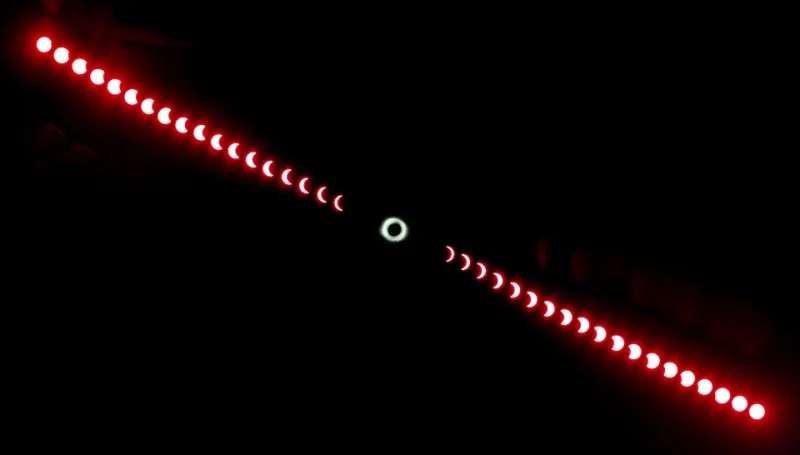
Photo: User:Kalan, CC BY 3.0, via Wikimedia Commons
On 12 August 2026, the moon's umbra will race across the North Atlantic, making landfall in Greenland before crossing western Iceland and northern Spain. For British travellers, this is the most accessible total solar eclipse of the decade: close enough for a charter, far enough to require a plan. The appeal of private aviation here is not luxury for its own sake. It is the ability to move with the weather, to choose an airfield near the centreline, and to keep the day's timetable under control when scheduled services are sold out or ill-timed.
Start with the path, not the aircraft
Totality is a narrow event. A few miles can separate a full corona from an ordinary dimming of the afternoon. In Iceland, the shadow arrives in the late afternoon; in northern Spain, it comes close to sunset. That difference matters operationally. Iceland offers more time after the event, but less certainty in the weather. Spain offers easier access from the UK, but a tighter departure window once the eclipse has passed. The duration of totality is measured in minutes; the decision window is measured in hours.
Spanish airfields: access versus atmosphere
Northern Spain presents the widest choice. Santiago, A Coruña, Asturias, Santander, Bilbao and Pamplona all sit within reach of the path, though not every one is equally convenient for the centreline or for a late departure. A Coruña and Santiago serve Galicia; Asturias and Santander cover the Cantabrian coast; Bilbao and Pamplona give access to the Basque Country and Navarre. The trade-off is familiar. Coastal airports may be convenient but more exposed to marine cloud, while inland positions can offer clearer skies but longer transfers and fewer handling options.
Private terminals and fixed-base operators will be under pressure around the eclipse. Parking may be scarce, slots may be coordinated, and handling teams may be stretched. A smaller airfield can be an advantage, but only if it has the runway length, night lighting and customs arrangements your itinerary requires. Confirm the practical details before assuming that proximity to the centreline is enough.
Iceland: high latitude, high variability
Keflavik is the main gateway, but Reykjavik, Akureyri and Egilsstaðir may be worth considering depending on the path and the weather. Iceland's appeal is duration and drama; its weakness is predictability. August weather can change quickly, and a clear forecast on the morning of the eclipse is not the same as a clear horizon at the appointed hour. Charter allows a last-minute reposition, but only if aircraft and crew are positioned to do so. An aircraft sitting in Keflavik with no onward slot is less useful than one that can move to a secondary airfield with capacity.
Timing the flight around totality
Spain's late totality compresses the post-eclipse departure window. Same-day return to the UK is possible in principle, but it should be planned as a late return, not a convenient evening one. Some Spanish airfields have limited night handling, runway lighting restrictions or local curfews; verify these before booking. Crew duty also deserves an honest look. A departure immediately after totality may be legal on paper but unwise if it leaves no margin for a delayed start, a weather diversion or a longer taxi than expected.
In Iceland, an earlier eclipse allows a more comfortable same-day return, but weather diversions may add time. If the forecast is marginal, arriving the day before is usually the more sensible use of a private charter than attempting to compress the whole exercise into a single duty period.
Weather contingencies and the honest limits of charter
Private charter improves mobility, not meteorology. A jet can fly from Bilbao to Santander or from Reykjavik to Akureyri, but it cannot outrun a frontal system if the airports are closed or slots are unavailable. The right contingency is a named alternate within a reasonable drive or short flight of the centreline, a handler who can turn an aircraft quickly, and a crew briefed on the possibility of a changed destination. Ground transport should not be an afterthought. A ninety-minute drive to a clearer horizon may be more reliable than a twenty-minute flight to a crowded airfield.
Aircraft, crew and the booking sequence
Light jets suit many Spanish itineraries; midsize or super-midsize aircraft give more flexibility for Iceland and for weather diversions. Range is rarely the issue on these routes. Performance, avionics, de-icing capability in marginal conditions and crew experience are more relevant. Book early, secure slots and prior permission where required, and choose a charter agreement that allows a sensible change of plan without punitive penalties. Appoint a handler, monitor forecasts from several sources, and prepare two workable plans rather than one brittle itinerary.
The honest verdict
Private charter is not a guarantee of clear skies. It is a risk-management tool. For 12 August 2026, it earns its keep when used to preserve optionality: the ability to shift airfield, to leave earlier, to stay later, or to reposition when the forecast changes. The umbra will not wait. The itinerary should be built around that fact, with the aircraft serving the observation plan rather than the other way round.