The One-Day Sortie Audited: Private Charter Against the Scheduled Cabin
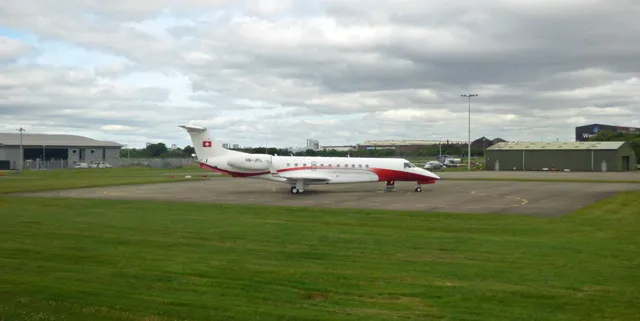
Photo: Thomas Nugent , CC BY-SA 2.0, via Wikimedia Commons
Private aviation is often sold on the promise of time. The claim is intuitive: turn up at a small airfield, walk to the aircraft, fly to a business airport close to the city, and step into a car. But a one-day business trip is a stern test. The question is not whether a private jet is faster in the air — it almost always is — but whether the door-to-door journey, including the waiting, the transfers and the return leg, produces a meaningful gain over a scheduled business-class cabin. In 2026, with European business travel back at full rhythm and airport terminals as congested as ever, that question deserves a colder look.
The door-to-door arithmetic
Take London to Paris, the most common same-day business hop from the UK. A light jet from Farnborough or Biggin Hill to Le Bourget might spend 1 hour 15 minutes in the air. Add 15 minutes at the private terminal, 10 minutes to the aircraft, 15 minutes to disembark and clear formalities, and 35 to 50 minutes by car into central Paris. The door-to-door total is roughly 2 hours 30 minutes to 2 hours 45 minutes, depending on London traffic.
The scheduled alternative from London City to Paris Charles de Gaulle is not as slow as private-jet marketing sometimes suggests. A business-class passenger arriving 60 to 75 minutes before departure, flying for 1 hour 15 minutes, waiting 20 minutes for bags and taking a 45-minute transfer will typically reach central Paris in about 3 hours 15 minutes to 3 hours 30 minutes. The private gain is real, but it is closer to 45 to 60 minutes than to half a day. Paris is the hardest case for private aviation because the scheduled product is frequent and the airports are relatively close to the city.
Zurich, Frankfurt and Amsterdam are kinder to the private proposition. A private flight from Farnborough to Zurich takes about 1 hour 40 minutes; the FBO is a short drive from the financial district. The scheduled flight from Heathrow is similar in the air, but the terminal process, baggage and transfer usually add 90 minutes or more. Frankfurt and Amsterdam show a similar pattern, particularly when the private aircraft can use a smaller airfield such as Egelsbach or Rotterdam. The time saving then becomes 75 to 100 minutes each way, which is enough to change the shape of a day.
Where the hours actually go
The private-jet calculation is not simply airport time saved. It is also the cost of uncertainty. A scheduled business-class ticket offers frequency: if a meeting overruns, the traveller can usually rebook onto a later flight for a modest fee or no fee on a fully flexible fare. A private charter waits, but the aircraft and crew wait at an hourly cost. Crew duty limits, slots at busy airports such as Le Bourget and weather delays can erode the advantage. In winter, de-icing and short daylight windows add friction.
The scheduled cabin has its own hidden costs. Security queues, gate walks and baggage reclaim are variable. A missed connection can cost a day. But for a single meeting in a well-connected city, the scheduled product is resilient. The private jet wins on control, not on an absolute guarantee of speed.
Productivity and discretion
A private cabin is quieter and more private. Sensitive documents can be discussed without neighbouring passengers, and the traveller can work until the aircraft doors close. On a 90-minute flight, however, the productive window is limited. Scheduled business class offers lounges, Wi-Fi and the ability to work at both ends. For a team of four travelling together, the private cabin becomes a meeting room in the air; for a solo traveller, the productivity gain is smaller.
Discretion matters in some sectors — corporate transactions, legal matters, private clients — and here private aviation has no direct substitute. But discretion is a separate benefit from time saving, and it should be valued separately.
The cost equation
Indicative 2026 pricing for a same-day return from London to Paris is £10,000 to £16,000 on a light jet and £16,000 to £24,000 on a midsize aircraft. A fully flexible business-class return on a scheduled airline might cost £400 to £900, or £900 to £1,400 on the most flexible fares. For a solo traveller, the private option is 10 to 20 times the cost. For six passengers, a £20,000 midsize charter works out at about £3,300 per person — still several times the scheduled fare, but closer to the cost of fully flexible business travel for a senior team.
The economics change when the trip involves multiple stops. A London–Frankfurt–Zurich–London day is difficult and expensive on scheduled airlines; on a private aircraft it is a single charter with one crew and one aircraft. The same applies to destinations poorly served by scheduled carriers or to meetings that require late changes.
Which trips pass the test
A one-day business trip genuinely justifies private aviation when several of the following are true: three or more senior travellers are moving together; the itinerary includes two or more stops; the destination is poorly connected or the arrival airport is materially closer to the meeting; the schedule is fixed and the cost of a missed meeting is high; confidential material or sensitive equipment must travel; or the return must happen after the last scheduled flight.
It rarely justifies the jet when a single traveller is visiting a city with frequent scheduled service, when the diary is flexible, when cost is the primary consideration, or when the meeting is close to a major hub airport. In those cases, business class on a scheduled airline is the rational choice, and a good charter broker should say so.
A practical verdict
Private aviation can win the one-day test, but not by the margin its brochure implies. On London to Paris, the gain is modest; on London to Zurich, Frankfurt or Amsterdam, it is meaningful; on multi-stop or poorly connected itineraries, it is decisive. The sensible approach is to audit the door-to-door day, not the flight time alone. If the private option saves two hours and protects a high-value meeting, it may be worth the premium. If it saves 45 minutes and adds cost and complexity, the scheduled cabin remains a very good product.