Paws Aboard: Flying Your Dog or Cat Privately from the UK in 2026

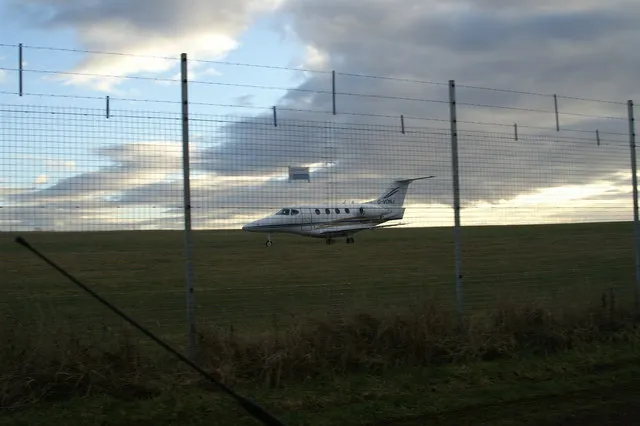
Photo: Basile Morin, CC BY-SA 4.0, via Wikimedia Commons
There is a particular moment familiar to anyone who has flown a dog in the hold: the handover at the cargo desk, the crate disappearing through a door, and the four hours of not knowing. It is not the animal's distress that lingers so much as the owner's. Private aviation does not abolish the formalities of crossing a border with an animal, but it does remove that moment. The pet stays with you, in a cabin you have seen before you board, on a schedule you chose.
That is the honest appeal, and it is a substantial one. What follows is what the arrangement actually requires in 2026, set out plainly.
The paperwork, in plain English
Great Britain has left the EU's pet movement regime, and the practical consequence is that a British-issued pet passport is no longer sufficient for travel to the EU. Instead, for each animal you will need:
- A microchip, implanted before the rabies vaccination and readable at inspection.
- A rabies vaccination, given at least 21 days before departure. Keep the vaccination record; it will be needed for the certificate and for any future travel.
- An Animal Health Certificate (AHC), issued by an Official Veterinarian. It must be issued within ten days of your date of entry into the EU and is generally valid for entry for that ten-day window, and for onward movement within the EU for up to four months. It is a lengthy document, and not every practice completes them routinely, so book the appointment early and check the vet's experience with the form.
- For dogs only, a tapeworm treatment administered by a vet between 24 and 120 hours before re-entry to Great Britain. Cats are exempt.
If you hold an EU-issued pet passport from a previous life abroad, it may still be usable for entry to the EU, subject to the rabies vaccination remaining valid. Your vet and your pet travel handler should confirm the position for your specific documents rather than relying on general guidance.
One further rule is often overlooked: the non-commercial movement regime allows a maximum of five animals per person. Beyond that, the movement may be treated as commercial, with entirely different requirements. Owners travelling with a large household of animals should take advice well in advance.
Cabin or hold?
On most private aircraft, pets travel in the cabin with their owners. This is the principal reason owners choose charter, and it is worth understanding the nuance. The commander retains discretion over the animal's placement and restraint, and the cabin of a light jet is smaller than photographs suggest. A large dog will usually need a crate secured to a seat or floor point, and some operators will specify the make and dimensions. Cats generally travel in a secured carrier.
Cargo compartments on modern business jets are pressurised and temperature-controlled, but not all are suitable for livestock, and not all operators will carry animals there. If the hold is your only option for a very large dog on a particular aircraft, ask the question before you fall in love with the itinerary.
Sedation is a matter for your vet, not your broker. Many vets now advise against routine sedation for air travel, particularly at altitude, and the decision should be made on veterinary grounds with the flight profile in mind.
Matching the aircraft to the animal
A turboprop or light jet is perfectly adequate for a short Channel crossing with a spaniel in a crate. Longer sectors with two large dogs, or a nervous animal, justify a midsize cabin with more floor space and better climate control. Tell your broker the breed, weight and carrier dimensions at the outset; a quotation built without that information will change.
Ask, too, about the operator's pet policy in writing. Charges vary widely, from a modest cleaning fee to a per-animal surcharge, and it is helpful to know before the invoice arrives.
Destinations that make it genuinely easy
The private terminals at Le Touquet, Deauville and Paris–Le Bourget are accustomed to animals and offer short, quiet arrivals. Girona and Palma handle pet traffic comfortably outside peak season, and Faro is a straightforward entry point for the Algarve. In winter, Innsbruck and Salzburg work well for owners heading to the Austrian Alps, though snow contingency planning is essential. Closer to home, Jersey and the Isle of Man sit outside the EU regime and follow their own rules, which your handler can confirm.
Wherever you land, arrange pet-friendly ground transport in advance. A hire car collected at an airport desk is rarely welcoming to a wet Labrador, whereas a pre-booked driver with a covered boot is not an extravagance.
Coming home
Re-entry to Great Britain is the step most often under-planned. The tapeworm treatment window for dogs is narrow, and it must be administered by a vet and recorded properly. Build a veterinary appointment into the final three days of your trip rather than hoping to find a practice at short notice.
On arrival, use a designated customs point and expect to present the documentation for inspection. Most private terminals handle this smoothly when the paperwork is in order.
What it costs, and whether it is worth it
Charter pricing depends on the aircraft, the route and the season, with pet surcharges typically modest relative to the flight itself. Set against that are the kennel fees, the uncertainty and the handover moment that private travel removes. For owners who regard their animals as family rather than freight, the calculation tends to make itself.
The practical rule is simple: start the veterinary work at least two months before departure, tell your broker everything about the animal on day one, and treat the paperwork with the same seriousness as the flight. Do that, and the dog sleeps under the table from Luton to Le Touquet while you read the paper.