The Family Charter, Considered: Planning School-Holiday Flights for 2026

Photo: Master of Astorga Active in Castile, first half of 16th century Details on Google Art Project, Public domain, via Wikimedia Commons
School holidays have a way of making ordinary travel feel like an exercise in crowd management. Airports fill, schedules tighten and the margin for error narrows precisely when families are least able to absorb it. For UK households considering private charter during half-term, Easter or the longer summer break, the question is not whether a private jet is more pleasant. It usually is. The more useful question is what a charter operator can actually arrange around children, grandparents and the paraphernalia of family life — and whether those arrangements justify the premium.
Why school holidays alter the calculation
A private charter is most persuasive when it removes friction that scheduled travel cannot avoid. During peak school holidays, that friction is concentrated. Terminal queues lengthen, baggage systems come under strain and the scheduled cabin offers little flexibility when a child needs to move, eat or sleep at an inconvenient moment. A private aircraft does not abolish the constraints of weather, slots or airport opening hours, but it does allow the journey to be shaped around the family rather than the family around the journey.
The caveat is that school-holiday demand affects private aviation too. Aircraft, crews and handling slots are finite, and the most popular departure windows — Friday afternoons before half-term, the first Saturday of the summer break — carry a premium. Families who can shift departure by a day or use a less congested airfield often find the economics improve without any loss of convenience.
Aircraft selection: cabin volume over cabin glamour
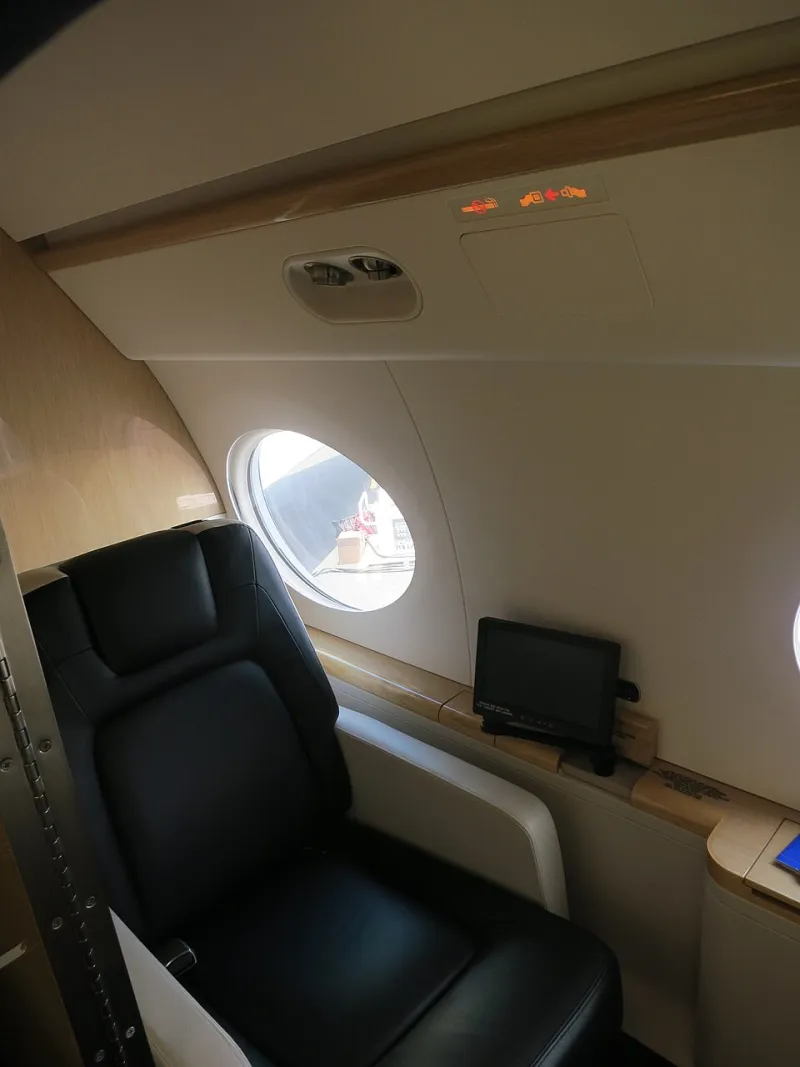
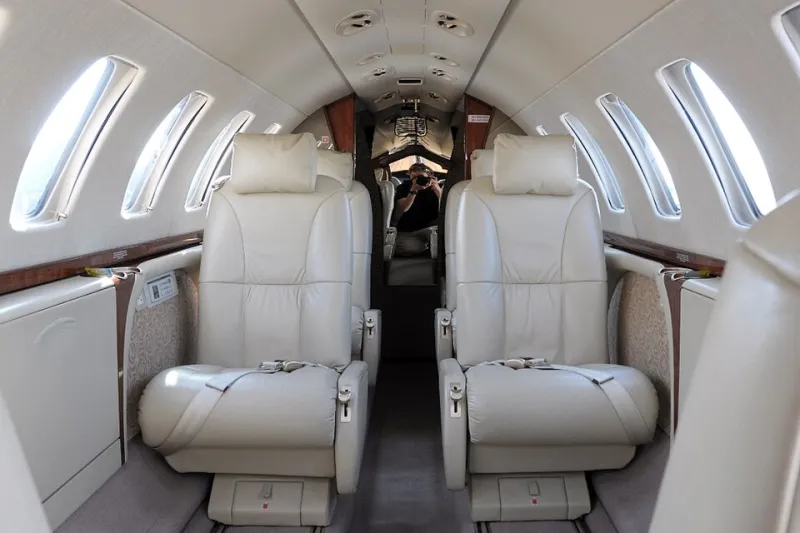
For families, the useful measure of an aircraft is not the polish of its interior but the volume and accessibility of its cabin. A light jet may be perfectly adequate for two adults on a short European hop; it is rarely the right choice for two adults, two children, a grandparent and the baggage that accompanies a fortnight abroad.
Midsize and super-midsize aircraft generally offer the best balance for UK family charters. They provide a stand-up cabin or near stand-up headroom, a separate baggage compartment that can be loaded without compromising the passenger cabin, and enough seat depth for child restraints to be fitted properly. Types such as the Citation XLS, Challenger 350 or Embraer Praetor families are common in this segment, though the precise suitability depends on the operator, the route and the number of passengers.
Where three generations are travelling together, a larger cabin may be warranted not because the flight is long but because the seating plan needs to accommodate different routines. A grandparent may wish to sit away from a restless toddler; a parent may need to sit adjacent to a car seat. Cabin layout matters more than cabin length.
Child seats, baggage and the practical cabin
Child restraint arrangements vary by operator and aircraft type, and parents should raise the matter at the quotation stage rather than at the aircraft steps. Not every seat is suitable for every restraint, and the operator will need to confirm what can be fitted and where. UK families should expect to provide the restraint itself unless the charter company has confirmed otherwise in writing.
Baggage is the other predictable pressure point. Private aircraft have generous allowances compared with scheduled carriers, but the hold is not infinite, and bulky items such as travel cots, pushchairs and ski equipment consume space quickly. A family of five travelling for a week may find that a midsize aircraft is adequate for passengers but marginal for luggage. Operators can advise on volume as well as weight, and it is worth being honest about the pushchair, the cot and the case of children’s books that will inevitably travel.
Catering that works at altitude
Child-friendly catering is not a matter of ordering from a children’s menu. It is a matter of timing, familiarity and avoiding the foods that taste different at altitude. A private charter can arrange simple, recognisable meals at the hour the family actually wants them, rather than according to a scheduled service. For younger children, plain pasta, fruit, yoghurt and sandwiches tend to travel better than rich sauces or heavily seasoned dishes.
Parents should also consider the return leg. A late arrival into a UK airfield often means hungry children and tired adults. A pre-ordered cold supper or a simple breakfast for the following morning can be more valuable than an elaborate lunch on the outbound flight. The catering brief should reflect the family’s routine, not an airline’s.
Seating plans for three generations
Multi-generational travel requires a seating plan before boarding. Grandparents may prefer seats with easier access to the lavatory; parents need proximity to younger children; older children may want their own space. On a private aircraft, these preferences can usually be accommodated if they are known in advance.
It is also worth discussing the cabin crew’s role. On many private charters, cabin crew are present but not in the same way as on an airline. They can help with catering and service, but they are not childcare. Families should plan on the basis that a parent or guardian remains responsible for children throughout the flight, with the crew providing practical support rather than supervision.
Terminal handling and the avoided bottleneck
The most tangible gain for families is often on the ground. Private terminals and fixed-base operators allow kerbside arrival, short walks to the aircraft and minimal queuing. For a family with young children, that can turn a stressful two-hour pre-flight period into a twenty-minute transition. During school holidays, when main terminals are at their busiest, the difference is more pronounced.
That advantage depends on choosing the right airfield. Smaller UK airports and private terminals can be calmer, but not all have the same opening hours or handling capacity during peak periods. Families flying from London and the South East may find Farnborough, Biggin Hill or Oxford more manageable than a large commercial airport, while those in the Midlands and North have comparable options at Birmingham, Manchester or smaller regional airfields. The operator should be able to explain the trade-offs rather than simply defaulting to the nearest airport.
Where the premium is justified
The additional cost of private charter is easiest to justify when it buys time, reduces uncertainty and keeps a family together. It is less persuasive when it simply replaces one crowded cabin with another, or when the aircraft is too small for the baggage and the seating plan. The sensible approach is to brief the operator properly: ages of children, restraint requirements, luggage volume, preferred departure windows and any mobility needs among older passengers.
For UK families, the school-holiday charter is not an indulgence to be waved through unexamined. It is a logistical service, and it should be judged on how well it performs. Done well, it removes the terminal bottleneck, accommodates the car seat and the pushchair, and allows three generations to arrive in reasonable humour. Done badly, it is simply an expensive way to discover that the cabin was too small. The difference lies in the brief.