Between Two Vernissages: Charting the European Art Year by Private Charter
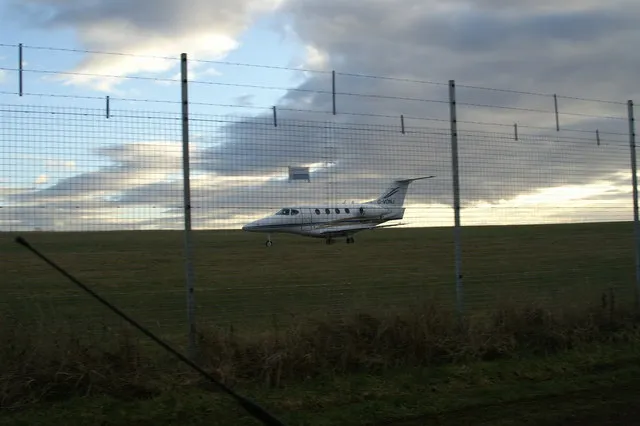
Photo: Adrian and Janet Quantock, CC BY-SA 2.0, via Wikimedia Commons
The art world keeps a calendar that is unusually unforgiving. Previews open on a Tuesday, the consequential conversations happen by Wednesday lunchtime, and the works worth pursuing rarely wait for a Thursday morning connection. For UK collectors, the difficulty has never lain in the fairs themselves. It lies in the connective tissue between them: the transfers, the timetables, and the narrow windows in which the right people are standing in the right booth.
Private charter's contribution to the art circuit is rarely glamorous. It is, more often, a matter of schedule integrity — the ability to leave a Basel preview on Wednesday evening and be in Venice by Thursday morning, with the intervening hours spent on the work rather than on the journey. Understood properly, the aircraft is not a statement. It is a device for protecting attention.
The Calendar, Read as a Route
Two pairings repay scrutiny in 2026. The first links Art Basel's June edition with the early weeks of the Venice Biennale, when the pavilions are still fresh and the city has not yet settled into high summer. The second links Frieze London in October with its Paris counterpart, turning what would otherwise be two separate weekends into a single, continuous and considerably more efficient tour.
Neither pairing is obvious to the commercial traveller. Basel-Mulhouse to Venice is little more than an hour in the air; London to Paris less still. What makes the itinerary work is not flight time but the ground: the transfer to a preview, the appointment with a condition report, the small number of daylight hours in which a decision can realistically be taken. A private aircraft compresses the first and protects the second.
Basel: A Slot Question Before It Is a Ticket Question
Basel-Mulhouse is a tri-national airport, and its handling arrangements reflect that geography. During fair week, demand for slots and parking rises sharply, and the discipline of booking early is not merely advisable but essential. A charter operator who knows the field will raise the question of slots before the question of catering, and will hold an alternative — Zurich, or a smaller Swiss field with a road transfer — in reserve.
The other Basel consideration is the sector of the airport used. Arriving on the Swiss side and departing from the French side carries different formalities, and for passengers travelling with documentation relating to a purchase, consistency is worth more than convenience. A single handling agent, briefed for the week, removes an entire category of small friction.
Venice: The Final Mile Is Water
Venice rewards those who plan the last mile as carefully as the flight. Marco Polo's general aviation facility is efficient and discreet, but the transfer from apron to water taxi, and from water taxi to hotel, is where the day is won or lost. Luggage travels differently on water; so do crates. A representative on the quay is not an indulgence.
For the Biennale itself, the two principal sites — the Giardini and the Arsenale — sit at opposite ends of a demanding walk, and June heat imposes its own timetable. An early arrival, before the first press tours disperse, is worth more than any ground transportation. Collectors who arrive by air the evening before routinely see more by noon than those who arrive on the day.
London: The Advantage Is Measured in Hours
Frieze London, held in Regent's Park, is the shortest leg of the circuit and paradoxically the one where private aviation earns least and matters most. The London airfields — London City, Farnborough, Biggin Hill — place a collector within half an hour of the fair, and the return leg is where the arithmetic becomes persuasive. An afternoon preview followed by dinner in Gloucestershire, or a morning at the fair followed by an evening flight to Edinburgh, are not feats of endurance but ordinary uses of the aircraft.
The Autumn Double: Frieze and Paris
The week between Frieze London and the Paris fair that follows it is now a fixture of the collecting year. Retaining a single aircraft across the week, rather than booking two separate charters, offers a consistency that is difficult to quantify but easy to notice: the same crew, the same cabin configuration, the same handling agent on both ends. For collectors travelling with a party, or with acquisitions, that continuity is worth the modest additional cost.
When the Purchase Comes Home
This is the part of the circuit that separates the experienced from the merely enthusiastic. Carriage of a significant work in the cabin is possible within limits of size and weight, and many collectors prefer it for reasons of condition rather than cost. Cabin altitude and low humidity must be understood before a decision is taken; so must the question of the courier's seat, and of insurance arranged at the value declared before departure rather than after arrival.
The documentation is a parallel track that should be prepared before the fair, not after it. Invoices, export licences where required, an ATA Carnet for works travelling temporarily, CITES permits for pieces incorporating restricted materials, and the import arrangements that apply to qualifying works of art on arrival in the UK — these are matters for a specialist adviser, and the sensible collector retains one for the season rather than for the transaction. Where a work is too large or too fragile for the cabin, freight is not a compromise but a correct decision, and the aircraft's role becomes the movement of the collector between fairs instead.
The Disciplines Worth Adopting
Three habits distinguish a circuit that works from one that merely exhausts. The first is to book the season rather than the flight: a broker briefed on the whole year will secure Basel slots in March and hold the August positioning intelligently. The second is to reduce the number of parties involved — one broker, one handling agent, one ground contact per city — so that accountability is clear when a schedule shifts. The third is to treat paperwork and catering with equal seriousness, because a missing certificate delays a departure more reliably than a missing lunch.
Private aviation does not make a collector's eye any sharper. It does, however, remove the accumulated delays that dull it: the missed connection, the cancelled return, the crate that cannot travel in the hold. On the European art circuit, that is the whole of the argument — and in 2026, with the calendar fuller than at any point in the past five years, it is an argument worth taking seriously.