Fog, Gales and Fine Print: What Private Flying Actually Buys You in a British Winter
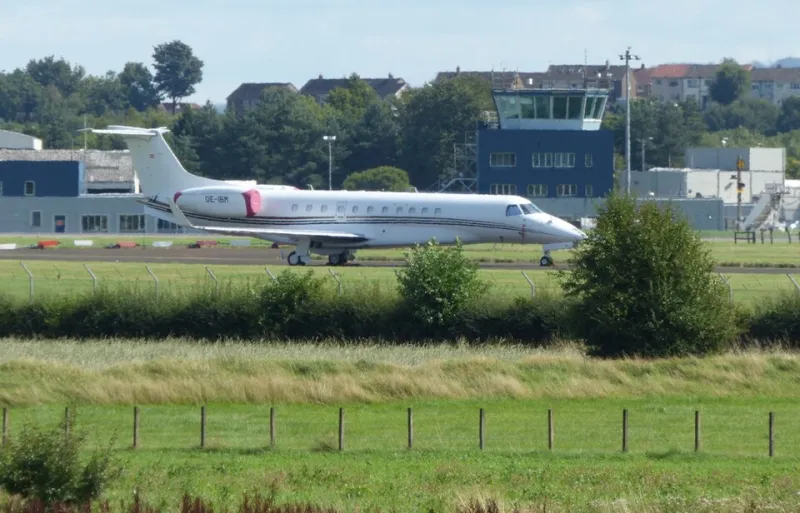
Photo: Thomas Nugent , CC BY-SA 2.0, via Wikimedia Commons
Private aviation has a useful habit of sounding like a solution to winter. The cabin is quieter, the terminal is smaller and the departure time is yours, until it is not. In the UK, the season from November to March can produce fog that closes runways, gales that narrow crosswind limits and air traffic control restrictions that affect every aircraft in the stack. The honest question for 2026/27 is not whether private flying is better than scheduled. It is what the premium actually changes when the weather takes charge.
The honest premise
Private charter buys choice, not immunity. It can place you at a smaller airfield, hold a crew for a later departure and rebook an aircraft with less friction than a scheduled carrier. It cannot lift a runway out of fog, ignore a crosswind limit or create a slot that air traffic control has not released. The distinction matters because winter disruption is often sold as a problem of queues and terminals. In reality, the binding constraints are meteorological and operational. A private jet parked at Farnborough is still subject to the same visibility minima as any other aircraft.
What fog does to a private jet
Fog is the great leveller. Low visibility can close an airport regardless of cabin class, and UK winters produce it in exactly the places travellers value: London City, the Thames Valley, the Midlands and parts of the North West. Smaller airfields are not automatically a remedy. Some have instrument approaches; others do not. An alternate may be open when the destination is closed, but the transfer that follows can consume the time saved. For a morning meeting in the City, a diversion to Oxford or Southend may still be useful. For a tight connection, it may simply relocate the problem.
Gales, snow and the de-icing queue
High winds bring a different constraint. Crosswind limits vary by aircraft and crew, and a runway that is open to a large scheduled jet may be outside the limits of a smaller charter type. Snow adds runway closure, aircraft de-icing and airframe contamination checks. De-icing is not a ritual; it takes time, fluid and a departure slot. On a busy winter morning, the queue can be as consequential as the treatment itself. A private operator may have more control over the sequence, but it cannot skip the procedure. Nor can it guarantee that a destination airport will stay open through a squall.
ATC delays are not a cabin-class problem
Air traffic control restrictions are perhaps the least understood part of the winter picture. Flow control, staff shortages and weather-driven capacity reductions affect all aircraft. A private charter may have more routing options and a greater willingness to wait, but it does not receive a separate sky. When a system-wide restriction is in force, the private cabin becomes a more comfortable place to be delayed, not a faster one. Buyers should be wary of any promise that implies otherwise. The right question is not whether the aircraft can fly, but whether the system will let it.
Where the premium earns its keep
The premium is most defensible when the problem is local and the alternative is costly. If one airport is fog-bound but another within reasonable driving distance is open, private aviation can exploit that difference. If a meeting can move by an hour, a held crew and a flexible departure can rescue the day. If a family or small team is travelling together, the avoided terminal time and the ability to change plans at short notice have real value. The same applies to multi-leg itineraries where a missed connection would cascade through a week. In these cases, the charter is not buying better weather. It is buying options.
Where it does not
The calculation changes when disruption is widespread. Regional fog, a named storm or a national ATC issue can close the gap between private and scheduled aviation to almost nothing. At that point, the sensible plan may be a scheduled flight with a protected connection, a hotel near the airport or an extra day built into the itinerary. A buffer day is unglamorous, but it is often cheaper than a charter that waits on the ground. Likewise, a scheduled backup is not an admission of failure. It is risk management. The private option should be judged on its recovery capability, not on the promise of a perfect departure.
A sensible playbook for 2026/27
For UK travellers, the practical approach is to decide in advance what the flight is worth. Build in a buffer for time-critical trips. Identify alternative airports and the ground transfer time between them. Ask the operator how it handles weather diversions, crew duty and overnight costs. Keep a scheduled option in reserve for journeys where the arrival time is non-negotiable. And accept that no charter agreement can override a red warning or a closed runway. The operators who are honest about this are usually the ones best placed to help when conditions improve.
Private aviation remains a powerful tool in a British winter, but it is a tool with limits. It can move the decision point, widen the airport choice and preserve a plan when the disruption is narrow. It cannot abolish fog, gales or ATC flow. The traveller who understands the difference buys the premium for the right reasons, and keeps a buffer for the days when the weather has the final word.